


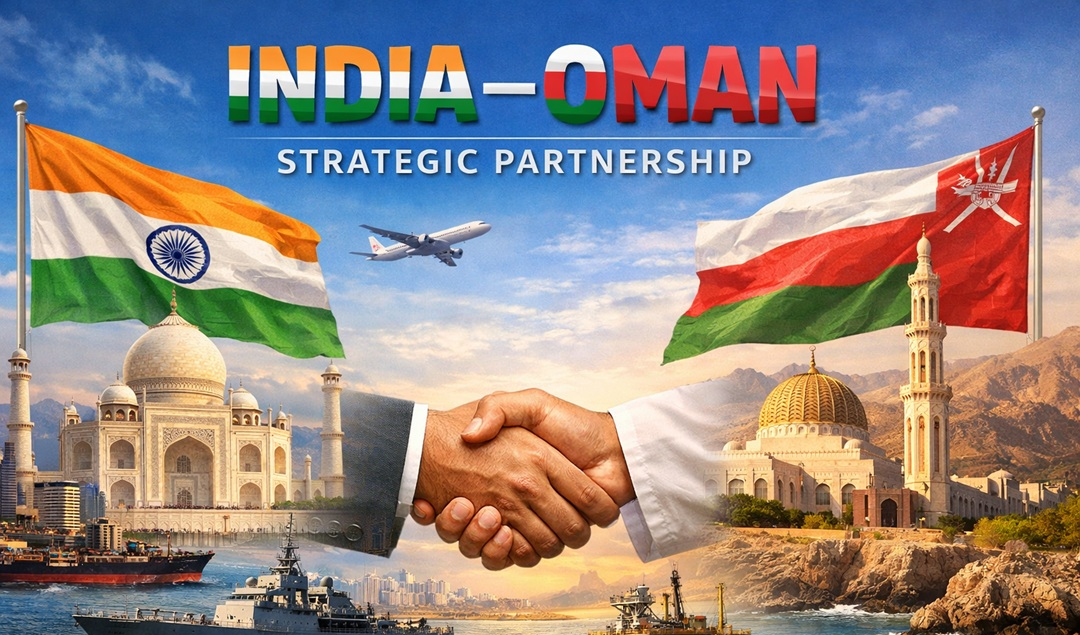
India-Oman CEPA
The strategic evolution of India’s trade relations in the Gulf has transitioned from transactional buyer-seller dynamics to deep-rooted economic integration. Central to this shift is the graduation from traditional Free Trade Agreements (FTAs) to the Comprehensive Economic Partnership Agreement (CEPA). While FTAs are often limited to the reduction of tariffs on physical goods, a CEPA facilitates a multi-layered convergence of economies. By encompassing services, investment protection, and regulatory alignment, the India-Oman CEPA creates a resilient ecosystem that reflects Oman’s status as India’s second-largest trading partner in the Gulf region.
The agreement was negotiated during a period of significant bilateral momentum, with trade volumes rising from $10.61 billion in FY 2024-25 to $11.18 billion in FY 2025-26. This growth provided the necessary economic justification for a more sophisticated legal framework.
|
Feature
|
Traditional FTA
|
India-Oman CEPA
|
|---|---|---|
|
Primary Focus
|
Narrow focus on preferential trade in goods.
|
Deep economic integration and institutional linking.
|
|
Services & Investment
|
Generally excluded or subject to high barriers.
|
Broad liberalization of 127 service sub-sectors and 100% FDI.
|
|
Regulatory Scope
|
Limited to basic customs procedures.
|
Includes IP Rights, Competition Policy, and Government Procurement.
|
|
Enforcement Scope
|
Primarily tariff-based market access.
|
Holistic partnership covering investment and regulatory ease.
|
Timeline of Implementation: The India–Oman CEPA officially entered into force on June 1, 2026. This framework serves as the legal and administrative bedrock upon which Oman’s physical geography is being operationalized as a primary trade gateway for Indian interests.
Geographic Advantage: Navigating the Strait of Hormuz Alternative
In the contemporary landscape of "Supply Chain De-risking," geographic diversification is a cornerstone of India’s Strategic Autonomy. Global maritime trade is frequently held hostage by regional volatility at "choke points," most notably the Strait of Hormuz. For India, which relies heavily on the Gulf for energy security and export revenue, the Strait represents a point of vulnerability where geopolitical tensions can lead to skyrocketing insurance premiums and shipping delays.
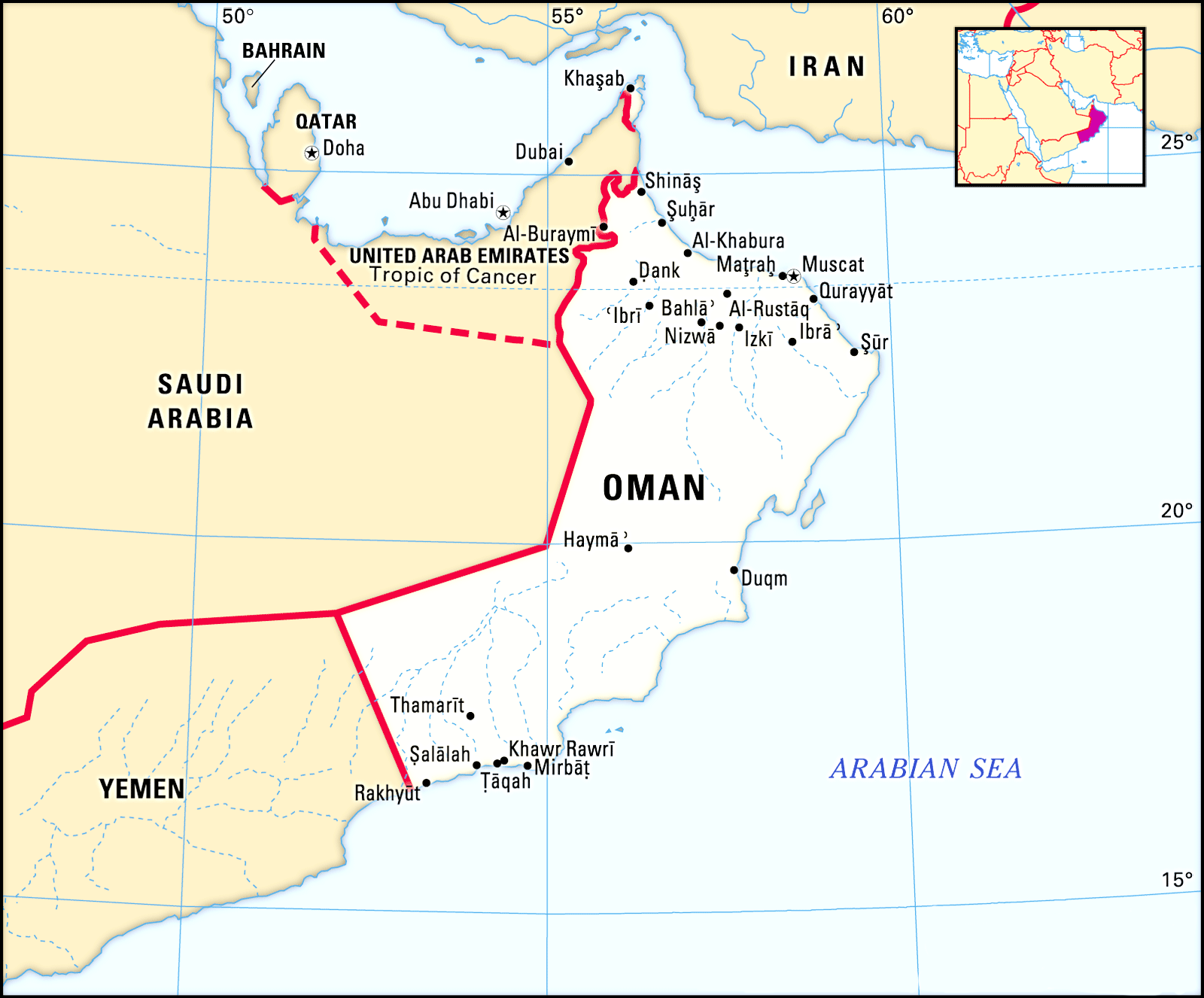
Oman’s unique coastline provides a decisive solution to these maritime risks. Unlike other GCC nations situated within the Persian Gulf, Oman’s primary ports face the open Arabian Sea and the Gulf of Oman.
- Bypassing the Choke Point: By utilizing Omani ports like Salalah and Duqm, Indian shipping can bypass the Strait of Hormuz entirely. This ensures a consistent flow of trade even during periods of regional instability, effectively insulating Indian commerce from naval blockades or localized conflict.
- Maritime Domain Awareness: This positioning transforms Oman into a "Strategic Gateway." For India's "Link West" policy, Oman is no longer just a destination but a secure, deep-water pivot point that reduces transit times and enhances the reliability of the India-Middle East-Europe corridor.
This geographic "luck" is the physical foundation for the logistics network that translates maritime access into market dominance.
The Logistics Hubs: Sohar, Duqm, and Salalah
The efficacy of modern trade agreements is determined by the "last mile" of logistics. Ports are no longer mere docking points; they are integrated industrial zones that determine a product's market reach and competitiveness. Oman has developed a tripartite network of hubs designed to capture different segments of global trade:
- Sohar: Positioned as the industrial engine, providing a gateway to the northern GCC markets and specialized manufacturing zones.
- Duqm: A massive, multi-sector hub that serves as a strategic link for energy-intensive industries and heavy manufacturing, located safely outside the Hormuz threshold.
- Salalah: Optimized as a world-class transshipment point, offering Indian exporters a direct "springboard" into East African markets and the wider Indian Ocean region.
Trade Facilitation: The "District-to-Duqm" Pipeline A critical administrative breakthrough under the CEPA is the acceptance of certificates from India’s Export Inspection Council (EIC). This move represents a sophisticated synthesis of international trade and domestic policy. By eliminating redundant testing and reducing transaction costs, this provision directly empowers India’s "Districts as Export Hubs" initiative. A manufacturer or farmer in a rural Indian district can now have their products certified once by the EIC and gain immediate entry into the Omani market, creating a seamless, cost-effective pipeline from India’s heartland to Oman’s deep-water ports.
Strategic Outcomes: Market Access and Economic Impact
The India–Oman CEPA cements a unique geopolitical status: India is now only the second nation globally, following the United States, to secure such a comprehensive bilateral pact with Oman. This achievement underscores the high degree of economic complementarity between the two nations.
Massive Market Access Metrics The agreement delivers an unprecedented reduction in trade barriers:
- MFN Regime Access: Previously, only 15.33% of Indian exports enjoyed duty-free status.
- CEPA Access: Under the new pact, 99.38% of Indian exports enter Oman duty-free.
Liberalization of the Services Sector Oman’s offer to India is the most comprehensive ever extended to a GCC partner. The opening of 127 service sub-sectors creates immense potential for high-value Indian industries:
- IT and Digital Services: Indian tech firms gain a stable environment for regional operations.
- Healthcare & Engineering: The provision for 100% Foreign Direct Investment (FDI) allows Indian hospitals and engineering firms to establish a permanent presence in Oman, servicing the wider region.
Socio-Economic Balance The CEPA utilizes a "calibrated liberalization" strategy. While maximizing growth for labor-intensive sectors and MSMEs, it maintains safeguards for sensitive domestic industries. This approach ensures that the "Oman Gateway" benefits the full spectrum of the Indian economy, from large-scale service providers to small-scale manufacturers.
Domestic Policy Integration: India’s Export Ecosystem
To ensure the CEPA does not remain a "paper agreement," the Indian government has aligned its domestic manufacturing and fiscal policies to maximize utilization.
|
Measure
|
Goal & Strategic Alignment
|
|---|---|
|
RoDTEP
|
Refunds embedded taxes; ensures Indian goods enter Oman with a price advantage over global competitors.
|
|
Export Promotion Mission
|
Provides the trade finance and certification assistance (EIC) necessary to navigate the CEPA’s regulatory framework.
|
|
Districts as Export Hubs
|
Decentralizes export power, linking local production directly to the Omani gateway to boost rural employment.
|
|
FTP 2023
|
Provides the overarching target of USD 2 trillion in exports by 2030, with the CEPA serving as a primary vehicle.
|
UPSC & Competitive Exams Module: News Analysis and Assessment
News Analysis: "India-Oman CEPA: Redefining Strategic Autonomy in the Gulf"
The implementation of the India-Oman CEPA marks a definitive maturation of India’s "Link West" policy. By securing a comprehensive partnership with its second-largest Gulf trading partner, India has moved beyond energy-dependency toward a role as a regional economic pillar. The strategic significance lies in the "Hormuz Bypass," which provides India with a resilient maritime alternative, thereby safeguarding trade and energy security against regional volatility. This agreement is a masterclass in using trade as a tool for "Strategic Autonomy," ensuring that India’s economic trajectory remains unhindered by external maritime choke points.
Critical Takeaways for Students
- Geopolitical: The "Strait of Hormuz Bypass" reduces insurance premiums and ensures supply chain resilience.
- Economic: A leap to 99.38% duty-free access for Indian goods; 100% FDI in services.
- Strategic: India is only the second nation (after the US) to hold this level of agreement with Oman, reflecting deep bilateral trust.
Multiple Choice Questions (MCQs)
1. On which date did the India–Oman Comprehensive Economic Partnership Agreement (CEPA) officially come into force?
A) January 1, 2025
B) June 1, 2026
C) April 1, 2023
D) December 31, 2026
- Correct Answer: B. The CEPA came into force on 1 June 2026.
2. Under the India–Oman CEPA, what is the extent of duty-free access granted to Indian exports?
A) 15.33%
B) 85.50%
C) 99.38%
D) 100%
- Correct Answer: C. The agreement provides duty-free access to 99.38% of India’s exports, up from 15.33% under the MFN regime.
3. Why is Oman's geography considered a "Strategic Gateway" for India compared to other Gulf nations?
A) It provides the only land route to Europe.
B) Its ports (Salalah, Duqm) allow trade to bypass the Strait of Hormuz.
C) It is the only country with a deep-water port in the region.
D) It connects the Arabian Sea to the South China Sea.
- Correct Answer: B. Oman’s coastline on the Arabian Sea allows ships to avoid the geopolitical risks and high insurance costs associated with the Strait of Hormuz.
4. How many service sub-sectors has Oman opened to Indian firms under the CEPA?
A) 50
B) 100
C) 127
D) 155
- Correct Answer: C. Oman has opened 127 sub-sectors, the most extensive offer to India by any GCC nation.
5. Which statement best describes the strategic significance of the India-Oman CEPA in the global context?
A) It makes Oman India’s largest trading partner globally.
B) It makes India the first nation to ever sign a trade pact with a GCC country.
C) It makes India only the second country after the US to sign a comprehensive bilateral pact with Oman.
D) It focuses exclusively on the trade of crude oil and natural gas.
- Correct Answer: C. India is only the second nation (following the US) to secure such a comprehensive bilateral agreement with Oman.
Mains Practice Question
"The India-Oman CEPA represents a paradigm shift in India's maritime trade strategy, moving beyond traditional market access to infrastructure-led strategic resilience." Discuss the significance of the 'Oman Gateway' in the context of India's trade and energy security.
Click here to
Read More

Are you sure?
You want to delete this comment..!
Remove
Cancel